COLLECTION DOSSIER // CHAPTER 02

Reading the Warm-Climate Collection

Under the persistent moisture and muted understory light of tropical rainforests, plants evolved astonishing morphology: gargantuan floating pads, fenestrated leaves, and aerial nutrient traps.

Victoria: The Botanical Engineering Masterpiece

The genus Victoria (notably V. amazonica, V. cruziana, and the recently characterized V. boliviana) represents the pinnacle of hydrophyte development. A single pad can expand at a rate of 15 to 20 cm in twenty-four hours during early summer.

Its structural undersurface features prominent radiating primary ribs cross-braced by secondary trabeculae. Air entrapped within this buoyant cellular framework allows a single mature leaf to support weights surpassing 45 kilograms when evenly distributed.

Epiphytic Survival in the Canopy Shade

Species within the families Araceae and Bromeliaceae adapt to saturated air without true soil. Philodendrons, monsteras, and anthuriums produce velamen-covered adventitious aerial roots capable of extracting liquid water and dissolved minerals directly from ambient fog and bark runoff.

Leaf fenestrations (the distinctive slits seen in Monstera deliciosa) minimize wind drag during violent tropical downpours while permitting filtered rays of photosynthetically active radiation to pass down to younger lower foliage.

Arborescent Pteridophytes and Palm Fronds

Tree ferns such as Cyathea and Dicksonia retain primeval vascular anatomy dating back over 300 million years. Rather than forming true secondary wood like modern dicotyledonous trees, their trunks are stabilized by a dense matrix of fibrous adventitious roots encasing a hollow vascular cylinder.

Notable Tropical Specimens in Public Collections

SPECIMEN LOG
VA
Victoria amazonica (Amazon Water Lily)
Native to the Amazon River Basin • Discovered scientifically in 1801
Water Temp: 28°C - 31°C
Thermogenic Bloom
MD
Monstera deliciosa var. sierrana
Native to Southern Mexico • Extreme laciniate foliage
Climbing Hemi-epiphyte
Shade Adapted
RF
Ravenala madagascariensis (Traveller's Palm)
Endemic to Madagascar • Strelitziaceae family
2D Fan-Shaped Distichous Habit
Water Well Petioles
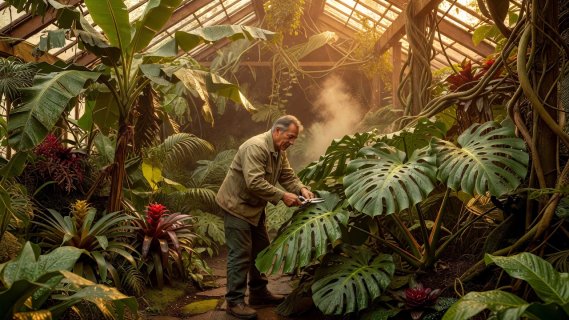
Botanical horticulturist tending to expansive humid foliage inside an amber warm greenhouse

Horticultural Care of High-Nutrient Aquatics

Cultivating giant water lilies outside their equatorial home requires deliberate feeding. A single *Victoria* specimen consumes weekly doses of decomposed manure, balanced slow-release nitrogen, and heated root-zone water maintained at precisely 29°C.

In municipal gardens like the Princess of Wales Conservatory at Kew or the Adelaide Botanic Garden, staff don chest waders to hand-pollinate nocturnal blooms and trim decaying leaf margins to avert fungal pathogens.