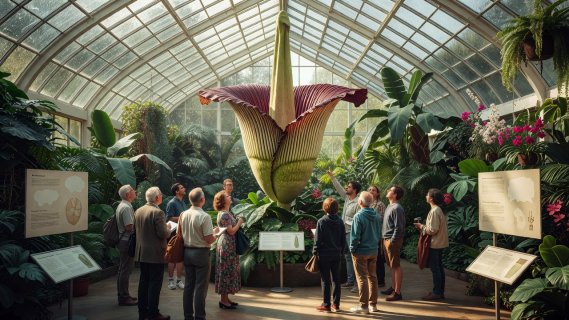
Unusual Blooms in Botanical Context
Flowers are evolutionary signaling devices. When an organism targets flesh flies, nocturnal bats, or specialized beetles, its floral morphology diverges into shapes, hues, and volatile chemistries that astonish human observers.
In botanical gardens, the flowering of an extraordinary species creates an electric public event. When an Amorphophallus titanum unfolds its vast spathe or the nocturnal queen of the night (*Selenicereus grandiflorus*) blooms for a single six-hour midnight window, thousands queue to witness what is essentially an extreme reproductive gamble perfected over millions of evolutionary cycles.
Selected Botanical Curiosities
MORPHOLOGY INDEXThe Chemistry of Deceptive Pollination
Why do titan arums and aristolochias smell like rot? In dense tropical habitats where sweet-nectar pollinators are overwhelmed by thousands of competing tree blossoms, exploiting carrion flies (*Calliphoridae*) offers an untapped vector.
These plants synthetically synthesize dimethyl disulfide (cabbage-like garlic), dimethyl trisulfide (foul rotten onions), and isovaleric acid (sweaty socks) while raising their internal temperature above ambient air to disperse the plume into forest canopies.